A circuitous route to Santiago de Compostela, Spain. Stage One beginning in Munich, Germany ending in Jerusalem - traveling through Austria, Italy, Albania, Macedonia, Greece, Turkey, Cyprus and Israel. Second stage from Vienna, through Germany, Czech Republic, Holland, Belgium, France and Spain.
Final destination - Santiago!

Post Script: The changeable situation in Jerusalem has led to a change in plans. The Rome to Jerusalem leg of this journey has been changed to the 'End to End' in the UK, after which the journey will resume as above in Vienna.

Sunday, 24 May 2015

The beginning of the end!

I am sitting in the huge, semi dark, upstairs dormitory of the refuge in Baamonde.  The sun has yet to rise, though it is now half light outside.  People are starting to stir, quietly, for a change and I would imagine that very soon the place will be buzzing.  Downstairs a few people have gathered for breakfast, but I will go to the bar a few doors down for mine.  Downstairs is where most people are sleeping - it is only the overflow and the latecomers, like me, who are upstairs.

Downstairs are two French women, two Swiss men, an American, and two Germans all walkers, along with a solitary Spanish cyclist, while upstairs I have shared the room with an older German man and a Czech couple.  I feel very sorry for the Czech woman as she has very bad tendonitis.  How do I know?  I can tell by the way she hobbles, because I have hobbled in exactly the same way!  I would like to be able to help her with some of the tips I have learned, but unfortunately I am not able to communicate with her at all, and from what I can gather neither can anyone else, which is unfortunate.
The albergue at Baamonde.
 The first stop of the day!  Cafe con leche and whatever is on offer for breakfast! 

Yesterday was a glorious day, walking past farms and through woodlands.  All along this part of Galicia the settlements are more spread out.  On the Meseta the farmhouses are gathered together in villages of varying sizes and then in Galicia further inland they are in little hamlets - perhaps three or four farm, with all there associated buildings, whereas where I have been traveling the buildings are spread over the countryside.  The people haven't changed though.  The older women have a distinctive shape to them.  The Galicians I see seem short to me, and the women are bent, perhaps from working in the fields.  The scarecrows in the paddocks look realistic because many are topped with a head scarf, making them look like a woman working in the fields.

There is a sense of excitement in the air, because this is the start of the last 100 kms.  This is the destination, and in most cases the end, of a journey of varying lengths.  Mine is a bit longer than most!  I have a couple of very long days ahead and so will be nursing my feet very carefully as they are getting sore, and probably, if I'm honest, tired!  This is a quick post as I doubt that I'll have internet for a few days.
 Leaving Vilalba I passed this interesting wall.
 The "mowers" have been out.
 A renovators delight.
 The path goes in between farm buildings, these few deserted.
 A well at a farm I was passing.
 An interesting little bridge to cross - no trolls!
It was under this monstrosity - not over!
Another cemetery. This type is described as being "somewhere between Gothic and Gaudian" in my guide!
 I love these slate fences that line the fields here in Galicia.
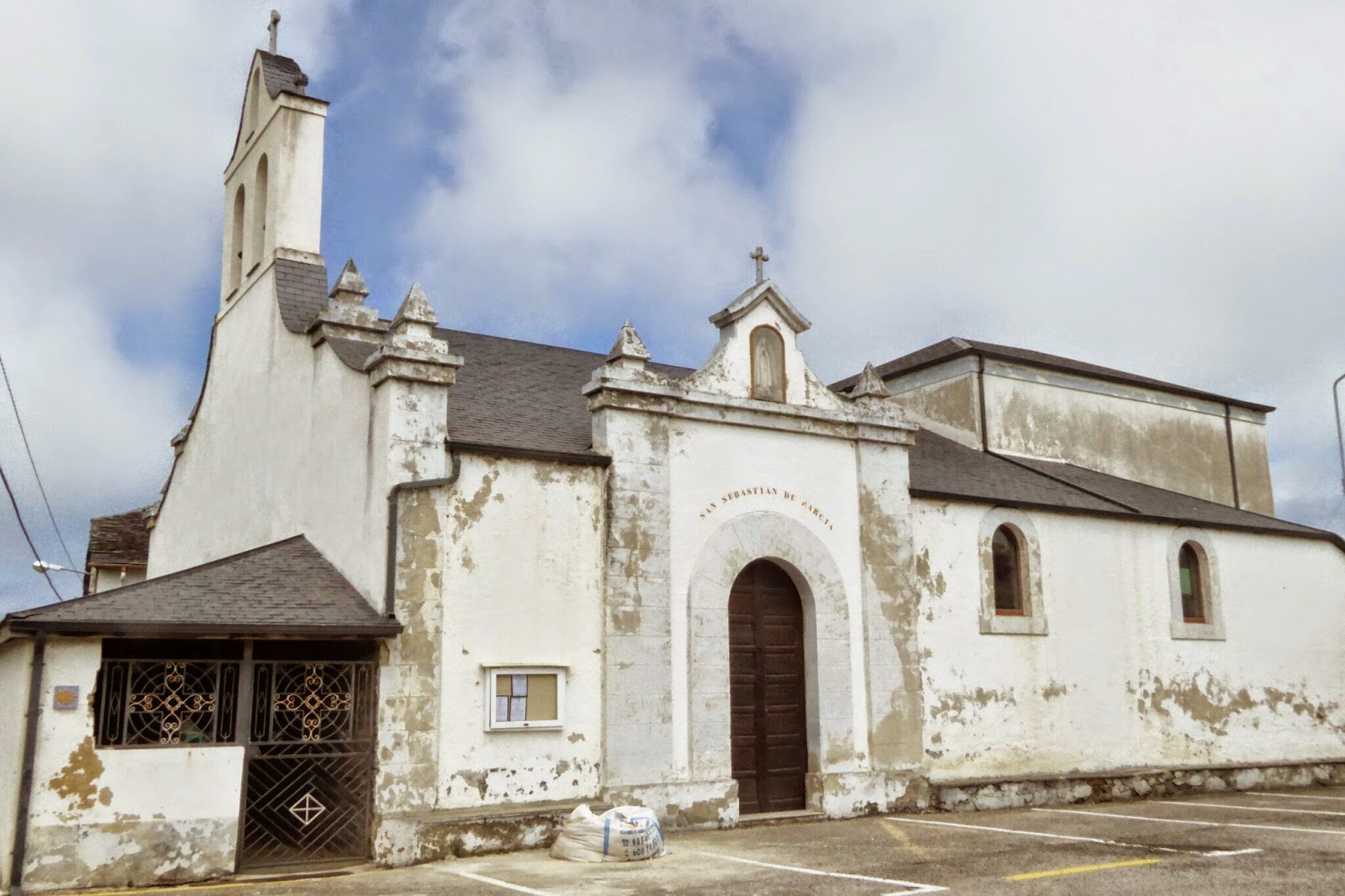
Baamonde Iglesia.

Saturday, 23 May 2015

Farewell Asturias, hello Galicia

I'm now out of Asturias and well and truly into Galicia.  I do like Asturias: its mountains, the way it oozes water, its square Horreos, and its quirkiness, so different to home.  One day while walking on the outskirts of a village I saw a couple unloading a car, or the man was, while the woman was placing the boxes of plants in the vege patch.  She was wearing clogs on her shoes which, which with their peg like stilts,  kept her feet above the dirt.

The quirkiness even goes to the shell waymarks, which in this region are back to front to everywhere else in Spain.  In Asturias we follow the closed part of the shell, but as soon as I crossed the bridge into Galicia the shells were inverted and now the open part of the shell points the way.

Galicia too has its individuality.  This is the land of small farming.  This is where farmers get out with a scythe to cut the grass, or go up market with a little petrol driven three wheeled "mower".  The tractors are many and varied, out in force at this time of the year, working in the fields like busy insects.  There are no air conditioned cabs in these tractors.  In the fields you can see the farmers and their wives forking the grass onto large trailers with forks.  As I've walked along the lanes these trailers have slowly passed me, either heading to the fields or back home.  One evening I was passed by a man and his wife returning home.  He was pushing a wheelbarrow loaded high with cut grass, while she, dressed in her " pinnie", carried the long fork.  It is a common sight in the afternoon to see a woman, always wearing her "pinnie" and a head scarf, bent over working in the vege garden.  They are oblivious to people like me walking past, intent on their work.

 La Caridad.

Prior to the building of the bridge across the Rio Eo at the border of Asturias and Galicia, pilgrims of old had to walk upstream to the village of Castello and cross there.  Now though, it is easy to cross, and of course shorter!
 The bridge at Ribedeo, with part of the marina.
The marina at Ribadeo.
An upmarket hórreo.
Looking down on the village of Ponte de Arante, before going up.
Descending into Vilamartin Pequeno.
St James on the exterior of the church at Lourenzá
Making sure we know which way to go leaving Lourenza.
This was a hard day.  The path goes over the hills in the distance on the left.
Here the path goes under the hórreo between the houses.

 Here it goes beside, and under the farm buildings.
 Looking down on Mondoñedo.
 The path fortunately stayed on the opposite side of the valley to the highway, though at the top of the hill, we went under it.
 The bells at the Iglesia at Goiriz......
 ...... and the cemetery behind.
The path after Goiritz.  Note the slate fence.
 The tower at Vilalba, now a Parador hotel.
The church at Vilalba. 

This is a very quick post as I'm not sure when I will get WiFi again.  I have quite a few long days ahead, but there is only a 120kms left to go.

Tuesday, 19 May 2015

Camino Del Norte in Asturias

There is a definite smell in the air.  Although I am still about 20 kms from Galicia I have been walking with a "Galician" smell for the last couple of days.  Those of you who have walked through Galicia will know to what I refer - silage, hay, and cows!  The roads though have been free of cow muck thus far, and I have yet to see a slurry tanker.

Walking in Asturias hasn't all been smelly though.  If it weren't for the architecture, language, and food I could almost be mistaken for being in the Adelaide hills, with the flowering shrubs in the gardens, helped by the milder weather in this part of Spain.  I always associate the eucalyptus with Galicia in Spain, but they are, sadly, just as prolific in this part of Asturias.  Combine the trees with the azaleas, rhododendrons, camelias, ti-tree, and callistemons and those of you who know the hills will know why I think that.

The other thing that has surprised me is the citrus trees in gardens.  In the village of Cadevado almost every garden had a lemon tree in it.

I caught the train to Aviles and crossing the road at the station I saw a man frantically waving.  I ignored him as I assumed he was trying to attract the attention of someone behind me and I didn't recognize him.  He recognized me though, as a pilgrim and it was me he was waving at.  He wanted to point me in the right direction, gave me a yellow arrow brooch, and sent me on my way.  Stopping at an intersection a bit further along a young woman stopped to point me on the way, and then another lady stopped and directed me further along still.  I knew where I was going, but they were obviously all doubtful!

I'm collecting yellow arrows as another man gave me one, a bit bigger, a few days later, and this morning a man gave me a photograph of the village so that I would remember it.
 The first church I saw in Aviles, one of four that I saw.
 These folk, clicked from a distance, were still sitting here an hour later when I came back to the square.
 The clock tower on the "Town Hall" in Aviles.
 A street in Aviles
 The Padres Franciscanos Church. The remains of the seaman Pedro Menedéz are in this church.  He founded the first town in the US - San Agustin de la Florida.
My first view of the coast after leaving Aviles - Salinas.


Election time in Spain is interesting.  Many of the villages have a special board at the entrance, or in prominent places where all candidates display their election posters.  The other thing that happens is audio advertising.  This takes the form of vehicles with posters of the candidate on them and a couple of loudspeakers on the top.  This vehicle then drives slowly around the towns and villages blaring what I can only assume are "vote for me" messages.  These vehicle's are even in quite remote rural areas - not sure who listens to them other than the pilgrims walking along.
                          
I wonder if people know how big these fellows grow?
An Asturian Hórreo at Cadevado.
The distinctive old buildings, including an horreó.

The path for the first few days was pretty tough.  Basically it followed a very windy road that snaked its way around the contours of the hills, but would take a short cut between each bend, which meant going down hill to, and across, the creek, often through muddy sections, and then steeply uphill to the road again.  Once through the village the downhill, cross the creek, then uphill was repeated.  It never went very high, maybe only a 150 meters or so, but from 20 meters low point this was an effort each time.
This creek flowed into the sea (below).

The view from the path. 
I was very relieved to see the path had been slashed over the past few days.  Reports had been that it was very overgrown.
Cadevado beach (above) and the little Ermita on a headland on the outskirts of the village (below).


Another horreó.  There is a plan afoot to make these protected.
What will they think of the modern bridges in a 1,000 years I wonder.  I stood on a bridge and took the road bridge, above, in one direction and an older rail viaduct, below,  on the other side.

On the way to Luarca I passed this little church. 

Luarca is a very pretty fishing village where I spent a very pleasant time exploring.  Also parted with €5 and got my washing done, washed and dried -  worth every bit of that especially as I didn't have to sit and wait for it.
Heading down into Luarca.  I couldn't help thinking this would rival the Cornish village where the TV series Doc Martin is set.

Luarca (above and below).  The little Ermita at the top of the picture on the right is where the path went the next day.


Another of those modern bridges after leaving Luarca.
A church on the way to Navia.
Navia (above & below) ..........
........... and just one example of a Callistemon.