A circuitous route to Santiago de Compostela, Spain. Stage One beginning in Munich, Germany ending in Jerusalem - traveling through Austria, Italy, Albania, Macedonia, Greece, Turkey, Cyprus and Israel. Second stage from Vienna, through Germany, Czech Republic, Holland, Belgium, France and Spain.
Final destination - Santiago!

Post Script: The changeable situation in Jerusalem has led to a change in plans. The Rome to Jerusalem leg of this journey has been changed to the 'End to End' in the UK, after which the journey will resume as above in Vienna.

Wednesday, 18 March 2015

Köln, in Germany to Maastricht, in Holland.

I was dreading leaving Köln, as cities are often unpleasant to walk into, and out of, along busy streets.  I was pleasantly surprised as the path took me through a lovely park, on a lovely day.  For the time it took me to get to Aachen I had sunshine everyday.  Indeed I had to take a layer of clothes off and didn't wear my beanie or gloves for the week.  I have even dug out my hat and worn it for the last few days.

Leaving Köln was interesting for another reason - a football match!  The path passed near the football stadium and so I walked with, and then against, the throngs heading to the stadium.  I had to cross a street where there were police in droves and dozens of paddy wagons lined up.  A man told me that they were there because a train from Frankfurt was expected full of "hooligans"!  I could hear them singing (the tune was Loch Lomond) for miles!

I met several lovely people along the way.  A couple of women in the park decided I was the wrong colour for an Australian - no suntan! Interestingly an English man who had visited Australia later made the comment that he was surprised how Australian women covered up, and he noticed how our women protected themselves against the sun!

Later this day I met another delightful woman who shouted me a coffee and spent a lovely hour chatting with her.  Indeed, I spent the day chatting to people the whole way, and those who know me will say - with a touch of sarcaam- " what a surprise"!  It was such a lovely day people were out in droves - cycling, walking the dog, or just ambling along the many paths.
My hotel in Köln (on left) and the spires of the cathedral in the background.
The Rhine at night.
Leaving Köln and the start of the park.
The police, cars, supporters in Müngeradorf.
Brauweiler (above and below)

Heading to Kerpen I met this traveller.  He didn't like my bright red back pack!
I had to invent the route I was to travel through the Königsdorfer forest.  I lost the markers, but found this along the way.
The crocus were flowering on the banks of the moat at the Schloss at Burgerhausen.
A sign in Spanish on the way into Golzheim.
More power plants!
The ruins of a monastery in the forest heading to Schevenhütte, on my way to Vicht (pronounced Fisht!)
This not so little granite character was reclining in a garden in Vicht.
Leaving Vicht I climbed up onto a lovely plateau, a nature park, which I was told later used to be an army training base and also, at some point, a dump.
The village of Breinig.  Here the buildings are made of bluestone, a change from the half timbered buildings.
The beautiful village of Kornelimünster.
The Benedictine Kornelimünster Abbey built in 814.

Aachen was a big surprise to me.  It was, for me, a surprise to come across some historical characters I had met on other parts of this journey.  The big character was Charlemagne.  I had no idea that Aachen was his capital.  There are references to him everywhere - a Charlemagne centre, a Charlemagne museum, the town hall has portraits of him as this was the place that began life as his palace.  I could go on but will stop at that.  Interestingly all the portraits and statues of him are different as there is no surviving pictorial record of what he looked like, and only a brief description by his friend and biographer which could fit many of you reading this!

The other surprise character was Napoleon.  Charlemagne was a role model of his and he visited Aachen, along with Josephine,  several times.

The other surprise, and it shouldn't have been, was the Roman heritage of the town.  A lot of the Roman evidence has been recycled, the walls for one being demolished over time and the stones being reused in other buildings.  This was a spa town, with hot springs coming from the ground around which the town was built.  In the garden in the centre of the town a structure has been built over archeological remains of a former Roman temple and hostel.  They would have made use of these springs back then just as the locals turned this into a very fashionable place of therapy and healing in the 1800's.  I watched people coming to the spring, around which a fancy building has been built, to fill bottles with the warm water pouring from the fountain.  I could also smell the sulphur in the air around it, reminiscent of Rotorua in NZ, but not as strong.
The Aachen cathedral (above and below).  It was part of Charlemagne's palace and the entrance is an ocatagonal shape.

A modern stained glass window in the cathedral.

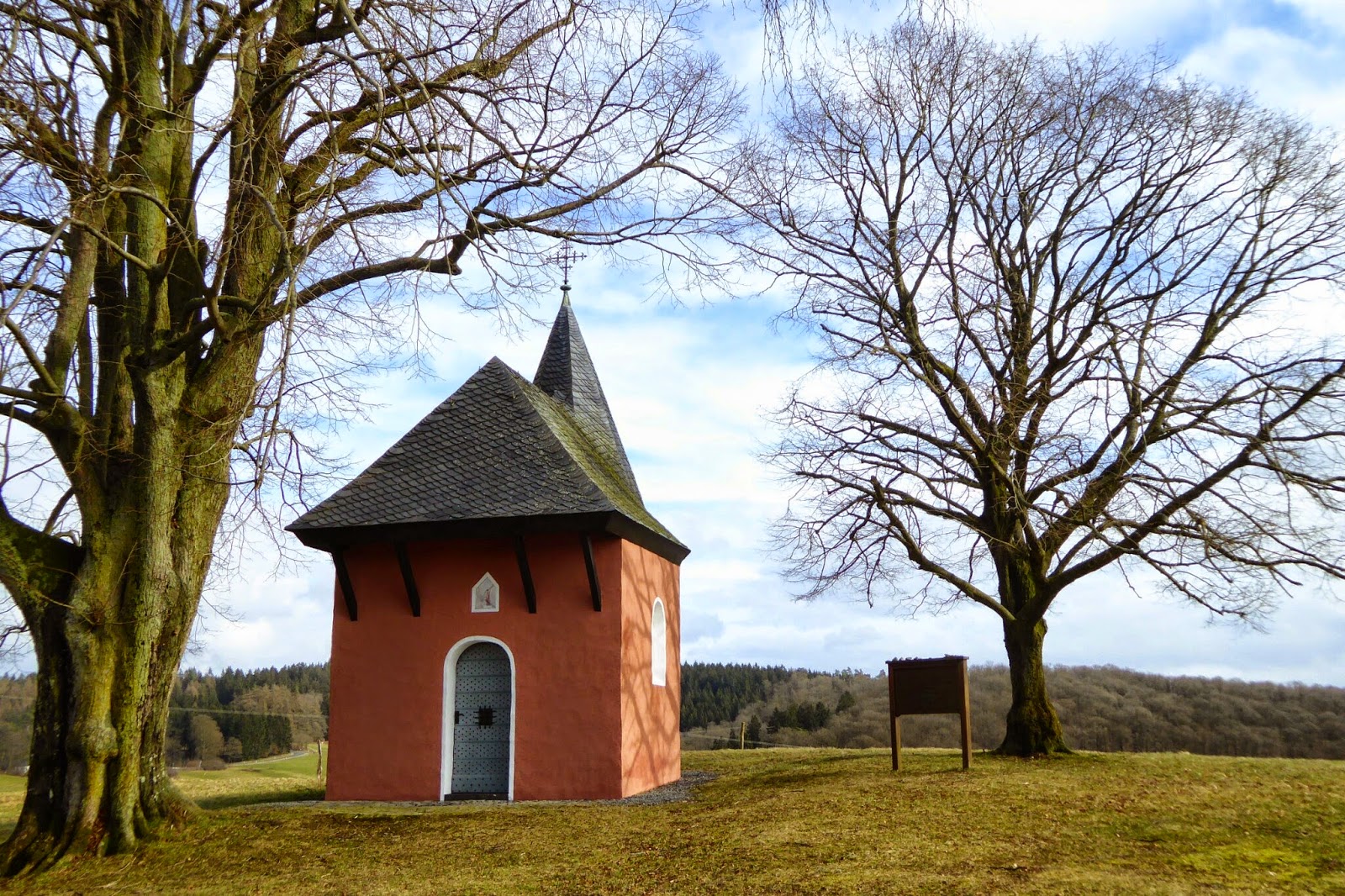
Below is a little chapel, recently built on the way.  Inside was a stake of the pilgrim St James (or in German - St Jakob)


Just one of the many churches on the way into Aachen
The Elisenbrunnen.  It was built in 1827, badly damaged during the war and rebuilt and restored to its former glory.  The Cathedral is in the distance.
A lady fills her water bottles at the fountain.
In the centre of the Elisengarten stands the protected Roman archeological dig, with the Elisenbrunnen in the background.
Inside the Coronation Hall in the Rathaus (town hall), venue for the crowning of 32 German kings.

There were some gorgeous statues in Aachen, but generally speaking the fountains are still not working, presumably in case there is more icy weather.

Heading towards Gulpen.  The village in the distance is Vijlen and somewhere between there and where I'm standing I crossed the border into the Nederland's.  I have no idea where, the only way I knew I was in another country was that the signs were in Dutch instead of German.
The village of Gulpen, my first stop in the Netherland's.
The path in the Netherlands was sometimes lacking in signs, and needed a lot of interpretation.  Eventually I figured that I was to follow the direction the little bloke on the left is headed.
I missed the heather in flower in Scotland but have seen plenty in flower here in recent days.
Heading into Maastricht.

Like Aachen, Maastricht was a surprise.  A truly lovely city.  Cobbled streets, old buildings, lovely churches and a river on which the barges travel up and down stream.  It is a very outdoor living city with many, many bars and cafes complete with chairs and tables on the pavements.
The river around which Maastricht is built.  The barges are frequent and fast.
One of the churches in Maastricht.
Vrijthof square lined with bike racks and bars.  This is the square where Andre Rieu holds his concerts in July.
This is the view of St. Servaas Basilica from the square.
The portico in St Servaas Basilica.
The Markt square in Maastricht.

Saturday, 7 March 2015

On the way to Köln, and now nearly across Germany.

Spring is well and truly on the way!  I am seeing, and hearing, signs everywhere.  The crocus and snowbells are blooming in proliferation, and now I'm seeing daffodils just starting to colour, and in plantings in the city they are actually flowering, along with plantings of pansies and polyanthus.  As well as these signs I think I can feel it!  For several days I have had only three layers on the top, and often no hat or gloves.  Yesterday the temperature got to 11° and today I noticed it was 13°.  Tomorrow the forecast is for 18°, though it won't be for long as the temperature is set to plummet in the days to come.
These are purple crocus, but I have seen white and yellow ones too.
Schneeglöckchen in bloom (Snowdrops)
 The first daffodils.
Spring flowers blooming near Köln Cathedral

Since leaving Marburg I have been obliged to make a couple of train journeys.  After spending over an hour in the Marburg Tourist Office and exploring every accommodation possibility I came to the reluctant conclusion that the only way to get to Siegen was by train - accomodation possibilities at this time of the year making it too difficult to walk.  Mind you, even catching the train was complicated as I had to go South to Giessen where I stayed overnight and then headed up to Siegen ready to walk.

This part of the journey has had a few more hill climbs than previous sections, with each morning seeming to begin with a particularly nasty ascent.  However, once on the top, the path mostly follows the contour lines, gently undulating through various forests and along the odd country lane.  On these ridges the views across the distance have been worth the effort, though the often biting wind meant the temptation to linger was dampened!
At the top of the hill, after leaving Siegen, I had icy snow to carefully traverse.
Looking back at the village of Oberfischbach.  As I walked up this hill a man called to me and while I tried to figure what (or rather, how) I could tell him what I was doing he came over with a chocolate bar in his hand - his actions said "to give you strength"!
Along the way I periodically come across logging ventures.

There have been, along this section, quite a few little chapels.  None were open, but seeing these little chapels along the path reminded me of Italy.
Kapelle Zur Schmerzhaften Mutter near Friesenhagen.
A few hundred metres further on there was St Anna Kapelle
This was the church in Friesenhagen itself.
Just before reaching Crottorf, at the top of a hill, was the Heilig Kreuz Kapelle
The ivy covered church tower in Drabenderhöhe
The man walking past this little church stopped and had a chat with me, in garbled (on my part) one word sentences, stopping and telling a passer by how I was an Aussie walking Jakobsweg from Leipzig (roughly 450 kms away).
I stopped here in Denklingen for a snack before pushing on to my hotel.
As I walked through Steinenbrück this old building with its crooked beams caught my eye.

Looking out at the village of Overath.
I didn't pause at this rest stop.  I could see a squall approaching and I was trying, unsuccessfully as it turned out, to get to my hotel in Bierenbachtal without having to put my raincoat on.  With 20 minutes to go it hit, rain and sleet combined with wind.

This stage of the journey has had some navigation challenges.  The signs disappear periodically and I have to use my sense of direction and instincts, combined with map reading and deductive skills.  Even so, there were a number of times when I walked without signs for some distance and was very relieved to see a sign appear.
This was a very suspect sign (the yellow splodge on the tree trunk) that I managed to see from 100 metres out on the road.

Walking into Köln was fairly tedious.  It was 10kms along the footpath.  After walking through a few forests for most of the previous day it was tough pounding the pavement into the city.  Mind you, 10kms was a shortish day and so I arrived in the city by lunch time.

Köln is a busy city, even in the off season.  There seem to be tours of every description going on with clumps of tourists clustered around their guide tell them stories in a variety of different languages.

When I went to visit the Cathedral a mass was about to begin.  Only those attending the service could enter and so I went in, at 10.30 on a Saturday morning.  It was apparent that this was a fairly important service, but a surreptitious peak at google made me none the wiser. There were all sorts of church dignatories, and the procession as they entered was a sea of colour.  Servers in red and white, priest and others in cyclamen pink and purple, along with the choir in white cassocks.  

It was the size of the choir that made me aware that it was a special service, which I later found out was a farewell for one of the Cathedral's leaders.  It was a real treat to hear the music at the service.  The choir was wonderful and it wasn't till things were underway that I realised there were two choirs.  The boys and men were at the side, very near where I sat.  I puzzled over why the conductor was using such large, expansive conducting patterns, until I spied, on a balcony, another conductor doing the same thing, copying the boss below!  He had behind him a slightly smaller choir of girls and these two choirs sang together, separately, and did some really interesting canons.  In between this when it was time for everyone to sing the organ thundered high above, jutting over the congregation.
The organ perched above the heads of the congregation.  I wouldn't like to be the organist - you'd need a good head for heights!
The Köln Cathedral, with a little tourist train in the foreground.
A street scene in Köln.
The sunshine brought everyone out to sit in the cafe's, still rugged up with coats, and rugs for the knees.