A circuitous route to Santiago de Compostela, Spain. Stage One beginning in Munich, Germany ending in Jerusalem - traveling through Austria, Italy, Albania, Macedonia, Greece, Turkey, Cyprus and Israel. Second stage from Vienna, through Germany, Czech Republic, Holland, Belgium, France and Spain.
Final destination - Santiago!

Post Script: The changeable situation in Jerusalem has led to a change in plans. The Rome to Jerusalem leg of this journey has been changed to the 'End to End' in the UK, after which the journey will resume as above in Vienna.

Saturday, 30 August 2014

Umbrian hilltop towns

Well, you haven't heard much from me for a number of reasons.  One is spare time and wifi coinciding, and the other is that my knee injury has curtailed walking for a while.

The latter reason has been really disappointing, but we have been following the pilgrimage route by bus and train, and with 2 exceptions, stopping at the same places.  Though we haven't walked we have seen almost all the things that we would have seen had we been walking.  Sadly, there have been a few hermitages we have missed because they are up high and off the beaten track.  This would not be a good scenario for my knee at the present moment!

I have posted a lot of photos of the hilltop villages we have been staying at.  They have been extraordinary to meander through, explore their churches and museums, and just sit in the piazza and watch the world go by!
The path up to Eremo delle Carceri, up Mt Subiaso, was rocky, and relentlessly steep.  We walked the five kilometres up, leaving our packs at the hotel in Assisi, but rather than put pressure on my knee on the descent I successfully approached some tourists for a ride down the hill.
Spello was the first of the hilltop towns, though little did we know that this one was a very gentle one.  As we progressed through the region of Umbria they got higher and steeper.
In Spello we stayed in the convent.  We were directed around to this tiny side door and once admitted, were allocated a room with two beds and our own bathroom, all for the cost of €25 each.
The streets were steep in Spello, but not as narrow  (or steep) as some that were to come in other villages.
Part of the castle.  Note the olive tree growing on the roof!
As a general rule railway stations don't have the best view, often being quite industrial areas, but we were quite content to sit and wait for a train with a view like this!
On the way back from the physio the taxi driver stopped so that I could take a photo of this amazing Umbrian hilltop town - Trevi.
Oil lamps burnt in the street.

We caught the bus up to the town, first going on a scenic tour through villages on the plain.  When we arrived, the bus driver having refused to take our payment, we were met by a fellow pilgrim who must have seen us get off the bus.

Domenico didn't speak one word of English, but somehow we worked out that we were heading to the same accommodation, which we hadn't book.  He took it upon himself to book us in as well as himself and he became our "guide", organising the taxi for me to go to the physio, taking Julie through a beautiful Palazzo (frescoes below), and organising an extra night in the " hotel" for us when he found out that I had to rest.

To say thank you to him I took him to the Church of San Francesco and sang for him.  He was so pleased he rang his wife and I had to sing for her on the phone!  I was really touched by the note he left for us the next morning, which read:-
A me, ricordando il canto avro' nel cuore un alito di gioia. 
Which google translates touchingly as:-
To me, remembering the song I'll have 'a breath of joy in the heart.


The organ in the Church of San Francesco, where I sang for Domenico.
The countryside surrounding Trevi is famous throughout Italy for the quality of the Olive oil.  There are thousands of trees, and apparently the rainfall and the rocky soil combined with the amount of sunshine help give the soil a nuetral ph.
The view from the palazzo garden towards Spoleto, though the town is hidden in the hills.
A final view of Trevi.  The taxi zig zagged its way down the hill for about three kilometres, before depositing us at a bar around the corner from the station.
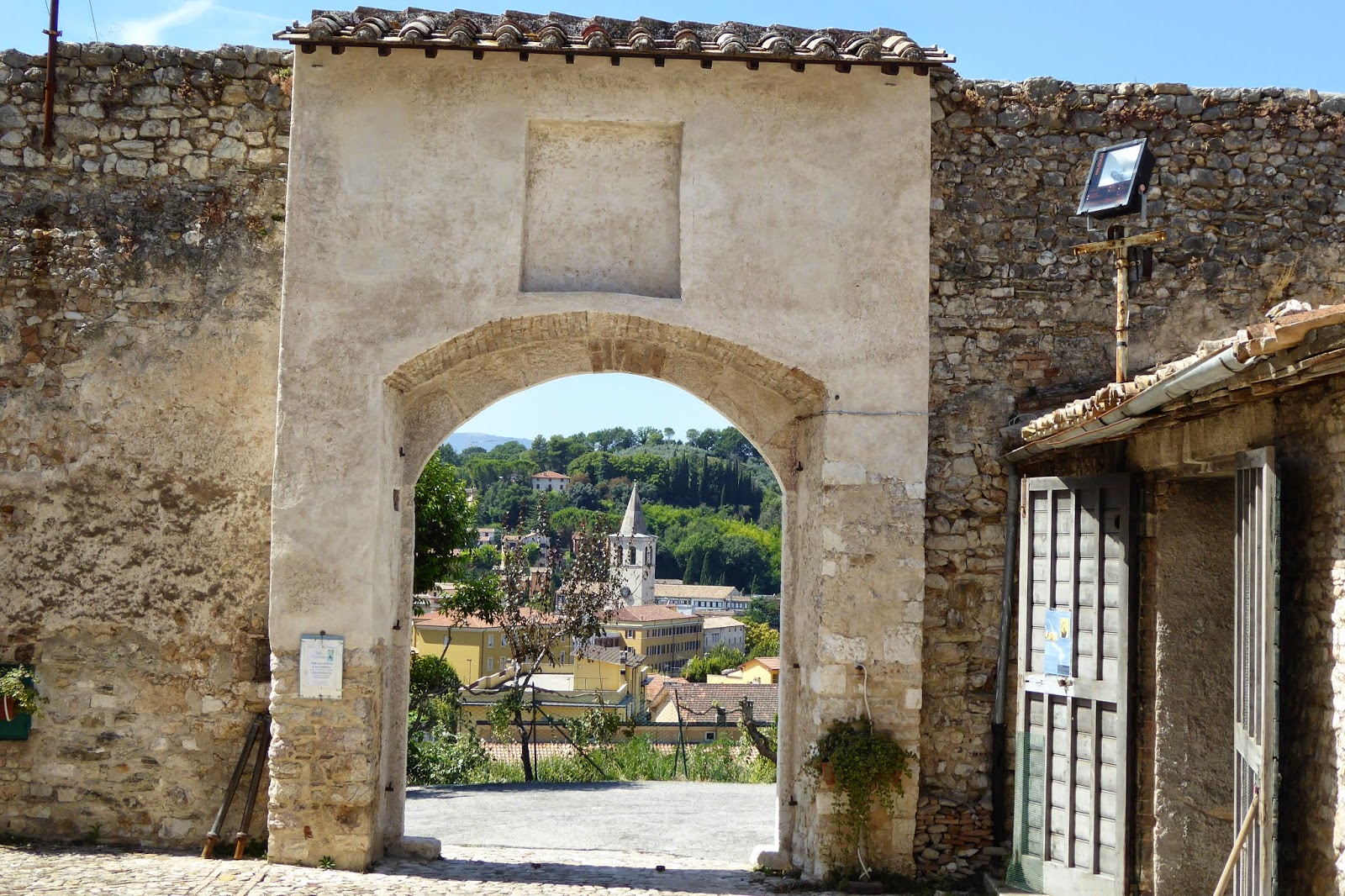
In Spoleto we stayed in another convent, next to Chiesa di San Ponziano.   This is the entrance gate to it, .......
....... and this is the building itself.
There was a crypt in the Chiesa, next to the convent, with columns so fine they looked as if they could barely support the vaulted ceiling, let alone the massive building above.
Another crypt in a different church, Chiesa di San Gregorio  Maggiore.  By contrast, these columns were straight rather than tapered, .....
.... and the church above had faded frescoes along the walls.
Spoleto, though on a hill, was very spread out.  The castle, the Rocca Albornoziana, had the prominent position, towering above the town.  There were about six escalators going up (you can just see the covers, to the left of the crane in the centre of the picture), and then elevators to go even higher.

For those of you who sing the praises of the Tuscan towns of San Gimignano and Montepulciano let me say that these towns, particularly Trevi and Stroncone, would rival them.  Indeed, I go so far as to say that they are better.  They don't have the towers, but the medieval streets well and truly rival them, especially Stroncone, which has installed a lift for its residents to get up the three stories into the town!
Stroncone was, like Trevi, perched on top of a hill.  If anything the streets were even steeper, windier, and narrower!


The view from the wall at Stroncone.  I think these were the hills we should have climbed!
 It was Fiesta time in Stroncone.  The drums were out, and the guards were changed three times.  The young ones got in some practise too!


I thought I had organised with the lady in the hotel to have our packs transported so that we could walk without me putting too much pressure on my knee.  However, it turned out that I had organised for US and our packs to get a ride.  Our taxi driver was her husband who took us on a wonderful scenic tour, stopping periodically for us to look at things, and for two thirds what a real taxi would have cost, taking two and half hours instead of an half hour!  I also sang for him at the church below, and when he eventually left us, as well as shaking hands, we were kissed on both cheeks!
 The convent San Francesco, at he foot of the wall in Stroncone.
Piedoluco - another church of San Francesco......
........ and one of the frescoes inside.
Lago Piedoluco, where international canoeing events are held.
The sanctuary of Greccio.  This is the place where, just a few years before his death Francis instructed his monks to assemble the first (living) Nativity scene.  There is a display of large and small nativity scenes from all around the world.
Walking up to the Sanctuary of Greccio.
Inside the Sanctuary.
The view from the Sanctusrio, looking out over the Rieti Valley.
The object of all the attention of the well dressed people in the previous photo.

Our hostess at Greccio is a delight.  She has provided us with a wonderful afternoon tea, organised her husband to take us to the bar for dinner, and collect us, and then organised for us to stay at a hostel tomorrow night - all for €50!

Tomorrow I am going to be brave and try walking!  My knee is still tender, but the rest has seen a big improvement, so we shall see what will happen.

Wednesday, 27 August 2014

Saint Francis

Assisi, and the many sights we visited to do with Saint Francis (below), was a rewarding and moving experience.
Saint Francis was born in Assisi into a fairly wealthy merchant family.  As a young man he liked to live the high life and would spend many evenings revelling with his friends.  He went into the family cloth business, travelling as part of his work.  After his conversion, much to his father's dismay, he gave up all worldly goods and dressed himself in a simple cassock of peasant quality.  His father brought him home and imprisoned him in a small, very small, room in an effort to change his mind.  This was an unsuccessful attempt, and Frances went off to travel the Italian countryside preaching and working with the poor and the sick, especially lepers, much reviled and outcast at the time
This was the room (now a little chapel) where the young Francis was born.  He was called John initially, until his father changed it to Francis on his return from a business trip in France, a place he was very fond of.
A statue of Saint Francis parents.
This is the floor level of the family cloth business, note the small door on the left.  They must have been so much smaller then - everything is shorter and narrower.
The room where Francis, as a young man was imprisoned.
The Basilica where Francis was buried, and some of the hoards of people that visit this extraordinary place.

At the time of Francis conversion he was instructed to "go and rebuild my church".  Francis took this literally, and rebuilt the tiny church of San Damiano, not realizing that it was a metaphorical instruction.  This Church was eventually given to Clare (known in Italian as Chiara), who established the order which has become known as the Poor Clare's.  They were given permission by the Pope to live a life of poverty, and he signed a document to say that it was their right to do so.  Clare too came from a very wealthy family and when she first fled to Francis and his followers, her relatives tried, unsuccessfully, to forcibly remove her. 

The path leading to the Church of San Damiano.
A little chapel on the way to San Damiano.
The Church of San Damiano, and a fresco on the wall (below).

Frances is buried in the crypt under the lower Basilica.  He died near the tiny chapel of Porziuncola, where Clare had fled to years before.  The monks leading the  funeral procession stopped at the chapel at Porziuncola and lifted Francis body up so that Clare and the other women now ensconced in the convent could view his body for the last time.
The lower Basilica is behind the doors in the centre of the picture, and of course the crypt is below that.
Looking up towards the upper Basilica.

The tiny chapel of Porziuncola is completely covered by this massive basilica, Santa Maria degli Angelo.  Pilgrims trek here to see the church where Clare fled to and found refuge with the monks holding vigil.  Despite the fact that this great edifice dwarfs everything around it, it is surprisingly moving to go into the tiny, beautifully proportioned Romanesque Church within these walls.  Photos are not allowed, and so I can't show you.

Francis, a well educated, erudite, and obviously personable man, very early in his life as an itinerate preacher, adopted the Tau as his symbol.  He signed all communications with it, and these days it has become a symbol of the Franciscans.  I quickly took this photo below as I walked towards the Church of Santa Maria degli Angeli.  Imagine my astonishment when downloading photos for this post when I saw the sky.  I'd you wonder what the Tau is, just look at the sky on the photo below - a very good example of one!
Santa Maria degli Angeli (above and below)

The cloisters.......
...... and a fresco within them.
There were some lovely statues in the garden adjoining the church.
The view of Santa Maria degli Angelo from our hotel room.

Clare was also buried in Assisi, at the opposite end of the town to Francis.  Her waxed body is in thw crypt of he Basilica of Santa Chiara.
Basilica Santa Chiara
In the crypt - looking towards where Clare's body lies.
The interior of Basilica Santa Chiara.
It was a delight, as I sat outside Basilica Santa Chiara to see Matteo come up the stairs.  He was one of the first pilgrims I met, way back in Dovadola, and here we both were at the comp!etikn of the Cammino di Assisi.

Francis was an itinerant preacher.  He practised what he preached, eschewing material things throughout his life, living simply.  He was a kind man, caring for the sick and the underdog. He was a man of peace, often playing the role of peace maker.  He lived a simp!e life, caring for all living things. Indeed , not only is he the Patron Saint of Italy, but also of ecology!

One can't help but wonder what this simple, educated man would think of the hype that surrounds anything to do with him, but at the same time one can understand the fascination and interest that he holds for modern man.
 Eremo delle Carceri, (above and below) one of the well known hermitages of Saint Francis.  This hermitage is on Mount Subiaso, and Francis and his friars would often go to the caves found here for solitary prayer.  It was especially moving to see the rocks where Francis knelt, and lay for sleep.  

Statues in the grounds of the Eremo.

Sunday, 24 August 2014

Assisi and Perugia.

I am going to have to do another post on Assisi, and tell you specifically about St Francis.  For now, let me catch up with general things.

We loved our night at Valfrabbrica.  Our hostess was a delight, as was the meal she cooked, and the company.  Up until now we have really only mixed with the small pelegrino family we had leaving Dovadola on the Cammino di Assisi,  but this night our companions were pilgrims who were walking the Cammino di San Francesco, which is the path that begins in la Verna and goes to Rome.

 We walked quite some distance out of Valfabrica to see this church, which was once the church attached to a Benedictine abbey. 
 The interior of the church, and below, one of the frescoes in the church.

The streets of Valfabbrica twisted their way from one end to the other.

Because of my painful knee we decided it was safer to catch a lift to Assisi, which we did with some companions from the previous night.  The road was longer than the path would have been, and after an early start we arrived at Assisi just on 9.00, with the streets still reasonably quiet.  The process then began of finding the tourist office and our hotel.  

Assisi is a beautiful town, set on a hill, with wonderful views out across the valley in one direction, and up narrow streets and alleys and over roof tops in the other.  There are many churches here, and many sights of import in relation to the life of St Francis, which I will show in another post.

The streets, during the day, are filled with tourists, along with nuns in habits and monks in their robes mingling amongst the crowds.
The streets of Assisi are often steep, and, as in this case, a street of steps for pedestrians only.
This Church is known as the temple of Minerva
You can see the age of this building from the pitting of  these pillars

I love the shapes that can be seen in such small spaces,
and doors are a constant source of interest.
Julie proudly holds her Assisiana.
The views are stunning, both downhill, 
and uphill.
I love the views through the "Porte's".
The little room that this monk is headed to is where the Assisiana is collected.  The Assisiana (a certificate) is prepared at the time we register in Dovadola, and was ready and waiting with our names printed on it when we arrived.

We caught the bus to Perugia to pay a brief visit to this extraordinary city, set on a hill.  Leaving the bus station we followed our noses, and a group of tourists who seemed to know where they were going, into what appeared to be an underground tunnel.  We found ourselves at the foot of escalators and headed up, and up, and up - into an area of tunnels.  We later discovered that this was actually the walls of a castle building that the Pope had instructed be built back in the middle ages.

While in Perugia we got caught in a torrential thunderstorm, arriving at the bus dripping wet!  The thunder was deafening at times, and the streets were awash.
The interior of the castle where we found ourselves.
One of the exterior entrances to the maze of tunnels in the walls.
The interior of the cathedral.  This is the first time I have seen marble to this extent on this trip.
The exterior of the cathedral was never finished.
The unusual shaped church of San Ercolana
The frescoes in this church were amazing
Looking into a side chapel in the Church
Tourist Julie admiring the view from the entrance to the Church.

We are now walking on the Camino San Francesco.  We have a different credential, the pilgrim passport which entitles us to stay in specific pilgrim accommodation, and we are approximately half way to Rome.  Because we have to be in Rome by September 7th to meet Jim, Julie's husband we will have to catch the bus a few times.  We will work out when and where as we go.

I will post later more on Assisi and St Francis.